Liquid Content in Publishing Practice
Eric Kubitz, Head of AI at Wort & Bild, is turning multichannel publishing on its head
Published: 9 July 2026 | Photo / Video: YouTube, Illustrations: Eric Kubitz/contentman
Not everything you are about to read will be pleasant. Some jobs will disappear, whilst others will be created – whoever ends up doing them. They won’t necessarily be qualified proofreaders, editors or content managers. Such is the new, analytical and dispassionate perspective of an AI and liquid content expert on publishing in the age of LLMs.
At the same time, things are becoming much easier for publishers embarking on the journey towards liquid content. A multi-channel approach is no longer a key factor for success. Editorial and marketing, for example, are growing closer together and demonstrating that they are two sides of the same coin. And the basis for all of this – a publisher’s own positioning – rests on a surprisingly small number of simple questions.
On top of all that, Eric Kubitz presents a concise starter guide for your first Liquid Content projects. After all, Liquid Content doesn’t have to start with a big bang.
With a bit of help, AI models can produce some bloody good content. So if you’re a publisher, content creator, journalist or author who wants to remain relevant in the future, you’ll need to come up with a strategy. Here’s a suggestion: move away from ready-made articles and towards a data core from which formats can be generated as and when required.
The publishing industry’s business model has two holes in it!
Websites – particularly those with run-of-the-mill content – are struggling and will find things even harder in future.
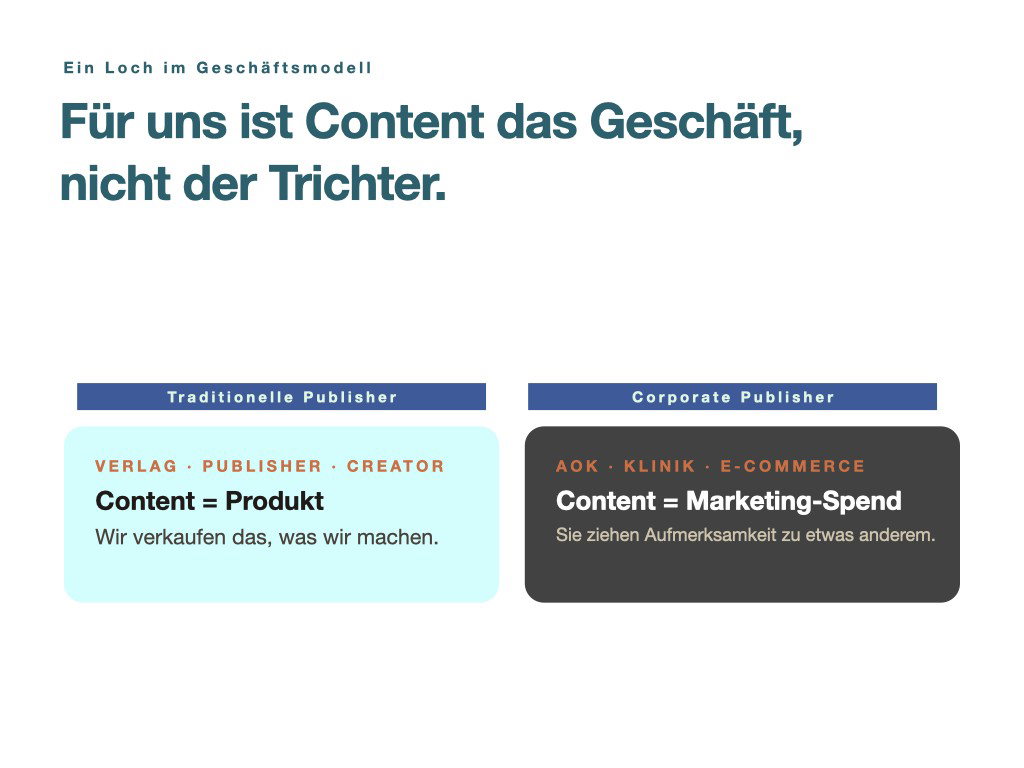
The first flaw in the business model:
Traditional publishers produce content because content is their product.
Corporate publishers – such as e-commerce firms, health insurance companies or tradespeople – produce content to sell products, insurance policies or solar panels. This may sound like a semantic quibble, but it is an important economic distinction.
For whilst ‘corporate publishers’ simply want to use the content to draw attention to themselves, pay for the content with marketing budgets and generate their profit margins from other products, traditional publishers have to make money directly from similar content.
And the second hole:
The LLMs (namely ChatGPT, Gemini, Claude, DeepSeek and many others) have long since processed our content and will continue to do so. All our content has long since been incorporated into ChatGPT and is helping AI companies to make money.
And to take it to the extreme: even if all traditional publishers were to ban LLMs from using their content – or even block their bots – there would probably still be enough content from corporate publishers to build good AI models for a while.
This is not a eulogy for journalism, because, despite everything, good times still lie ahead for publishers. Good features, columns, interviews, commentaries – AI cannot do any of these things at present, and is unlikely to be able to do so in the future at a level that can rival strong craftsmanship. What we must acknowledge, however, is that run-of-the-mill commissioned content, churned out haphazardly, no longer pays off. Neither for publishers nor for freelance journalists.
And one element will be ‘Liquid Content’.
What Liquid Content is not
What is ‘liquid content’? Is it simply a matter of turning a long text into an audio version, a video and an FAQ? So, just pushing more content onto other channels and hoping it works?
I think that’s the wrong approach. Or, to be more precise: it’s an approach that ends up in a complexity trap.
Because the moment a single article is split into five different formats, you need five workflows, five rounds of coordination and five quality checks. And what if the article needs updating next week? Do all five formats then have to be updated as well? That isn’t scalable. It’s a recipe for exhaustion.
What’s more, our readers can, for example, create their own audio versions of our articles with very little effort. And anyone who can’t do that yet will soon be able to.
So ‘liquid content’ does not mean ‘a piece of content in many formats’. ‘Liquid content’ means: a core set of data from which formats are generated as and when required.
- Advertisement -

The Core Asset Approach: What ‘liquid content’ really means.
At the heart of this architecture, it is no longer articles that take centre stage, but a data core. Most publishers are already familiar with the term RAG (Retrieval Augmented Generation). But such terms and technologies change very quickly. That is why we say ‘data core’. In any case, everything one knows and has researched flows into this core:
Existing content (articles, blog posts, dossiers)
Research — including unpublished work
Transcripts, notes, expert interviews
Feedback that users have given you
External, freely available material (guidance documents, open data)
Branching out from this core are a range of channels: a website, a newsletter, a podcast, a social media presence and a chat feature. This is a conversational form of content that simply answers readers’ questions, thereby keeping them on the site.
But — and this is the point — the spin-offs all draw on the same core story. You no longer write the same story five times in parallel. There is a well-developed core story, and from that, as and when required, formats are created that work.
This isn’t really anything new: back when I was working as a freelance journalist for lots of major magazines, I had to research and organise mobile roaming charges in Europe, for example, to give holidaymakers useful money-saving tips for their holidays. On top of that, there were interviews with service providers and hardware recommendations. My trick for making this very tedious and frustrating research worthwhile was this: I used it as the basis for writing various articles, each tailored to the specific magazine, complete with different service boxes. And here’s the crux of the matter: every single one of these articles was derived from my massive Excel spreadsheet full of cross-references. With this ‘core asset’ approach, all the work remained accessible and adaptable, and I earned my own holiday every year thanks to it.
Let’s now swap the magazines for different formats and channels, and we have ‘Liquid Content’. The research becomes the raw material for other formats – for chat replies, for a follow-up article, for a podcast discussion and perhaps even for a talk. That is the real economic lever.
Our role is changing — but not in the way we think.
Publishers face a major challenge. However, it is primarily the routines that produce run-of-the-mill content that are under threat. In other words: commissioned articles churned out using a set formula, made-to-order content marketing texts, and SEO filler. An AI with the right prompts can already do this today, and will be even better at it the day after tomorrow. Anyone who’s still doing this entirely by hand today should consider a career change. Yes, I mean that seriously.
By contrast, jobs that involve producing specific types of content are less at risk: columns, feature articles, interviews, commentaries and debates. Anything that involves a particular stance, style or keen eye for detail – qualities that stem from a person.
And there’s a new specialism: content architects. People who no longer just write content, but build systems in which content remains usable. The core skills are: researching, curating, advising, developing formats and testing them. This requires a willingness to experiment — and the courage to work in small, diverse teams rather than in large, formal meetings.
The Liquid Content Triangle: Reach, Engagement, Revenue
To get started, you need a strategic framework. Content always operates within the three key areas of a given field – and for each field, you need at least one tool or channel.
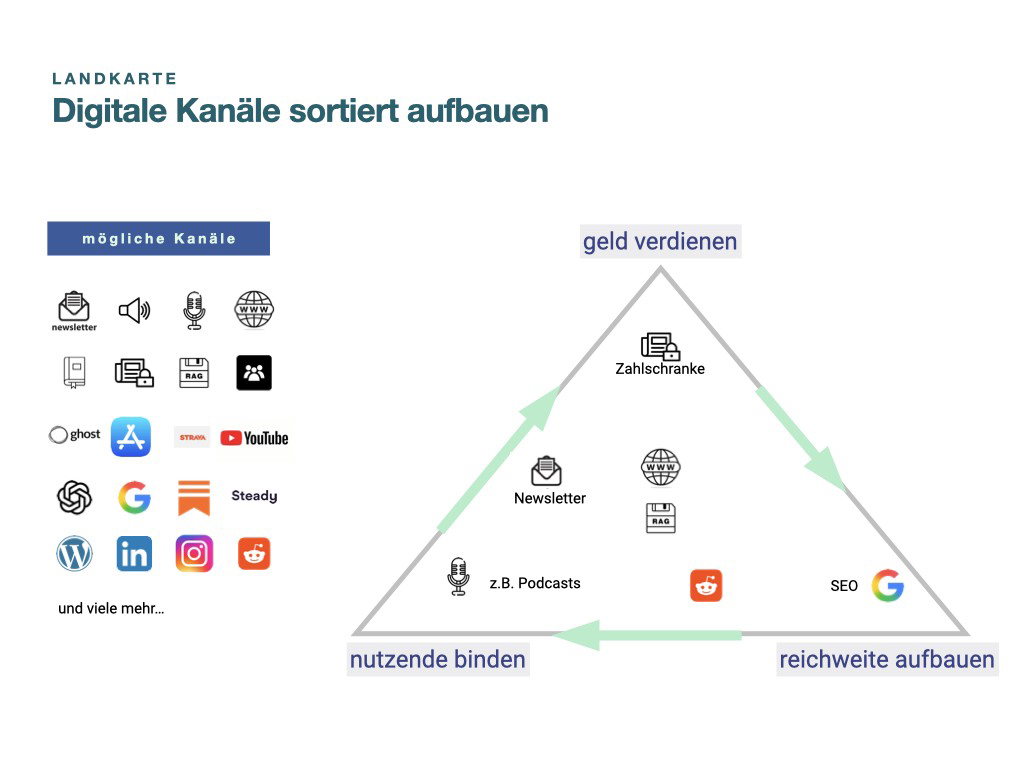
The Liquid Content Triangle
Building reach — How do people actually find out about you? In this case, through SEO and Reddit.
Retain users — How do you build a relationship with visitors? It could be a newsletter or a podcast. Or simply a login.
Monetise — How does that translate into revenue? If your content manages to attract subscribers, that’s great. Otherwise, it might be workshops or other business models that provide the funding.
The appeal lies in the circular nature of the process. Reach turns into engagement, and engagement turns into revenue. And if you treat your users well, they’ll help you expand your reach. The triangle closes to form a cycle.
What matters is not which tools are included, but that all three corners are covered. A channel focused purely on reach but lacking engagement will fizzle out; a paywall with no reach will wither away. And in the middle – and here I’m a traditionalist – lies a website, perhaps technically a RAG.
By the way: Fewer channels are the answer, not more. Anyone managing 38 tools or channels simultaneously spends their day maintaining those tools rather than creating content. A few channels that work together seamlessly are better than twenty that run in parallel.
The heretical twist: Forget target audience analysis!
And now for an uncomfortable truth: anyone who has commissioned comprehensive target audience analyses in recent months can probably just delete them. I mean that seriously, too.
Not because target audience analysis is fundamentally flawed. But because we are currently caught up in a technological tide that is moving at breakneck speed. Even after hundreds of in-depth interviews with real people, the insights gained are limited: how are they supposed to know what they’ll need in six months’ time, when they’re still only just figuring out what ChatGPT actually means for them?
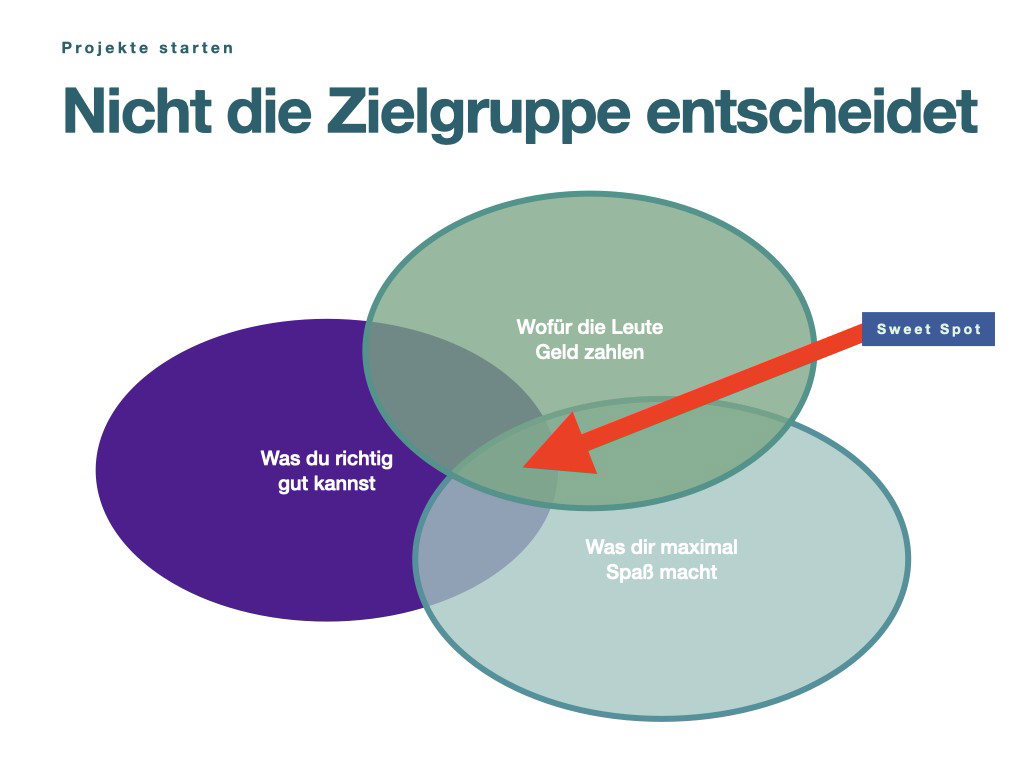
My suggestion as an alternative — and yes, this is my twist, my point that deliberately goes against the grain: don’t think in terms of the target audience, but rather in terms of the intersection of three questions:
What are you really good at?
What do you enjoy most of all — in other words, what would you spend your time doing even at the weekend?
What would people be willing to pay for?
The overlap will always be a niche market. And it doesn’t have to be huge. Around 100 million people live in German-speaking countries. By that measure, one million people is a small niche market. But even if only 10,000 people are interested, that can still support a number of well-paid jobs.
Of course, you have to look at what people are happy to pay for. But we can see this in the people around us too: what do they spend their money on? What would they buy if it were available? And one thing is certain: if you do something you don’t enjoy doing, or perhaps aren’t even very good at, you won’t succeed.
How to get started: From the LM notebook to your own RAG
A brief overview: Two years ago, a RAG (see above) was still rocket science; today, a simple RAG can be created using affordable resources. Text content is uploaded to such a semantic database; the system breaks it down into small units (known as ‘chunks’) and stores it in this form. When a question is received, the system searches for the relevant chunks and uses an LLM to formulate a response based on them; if required, it includes a source reference. The key point is that the system responds based on its own factual database, not on general knowledge from the internet.
Depending on your starting level, the effort required can be scaled:
Entry-level model: Google LM laptop. Free of charge, and ready to use in about ten minutes – ideal for freelancers. You can upload up to several hundred documents and query them in depth. Notebook LM can also generate articles, FAQs or those famous podcast dialogues on request — all based solely on the uploaded content, with source references. If you haven’t tried RAG yet, start here.
Intermediate level: Your own GPT or Gemini-Gem. If you find Notebook LM too small, you can build one or more GPTs (in ChatGPT) or Gems (in Gemini) or knowledge bases in Langdock. Advantage: here, you can define the role, tone and boundaries more precisely. The rule ‘less is more’ applies here too. It’s better to include 20 high-quality documents than 200 average ones. The quality of the sources trumps quantity.
Complex level: Own RAG. If you want independence, build your own RAG. This is technically more challenging, but not impossible. For specialised applications – for example, where it needs to be particularly secure or well-structured – good agencies can help by providing effective solutions. The important thing is that the data belongs to the publisher; they determine the model and can also make their system available to others (for example, for syndication).
There are other options as well. It is important that the core data contains high-quality, focused and up-to-date content. Redundant, unfocused and out-of-date content is of little use.
The smoke test for your first RAG
To ensure that the RAG can really be relied upon, it needs to be tested. This is straightforward: to do so, artificial information is generated that does not appear anywhere else on the internet. Made-up names, fictitious rules, invented prices. If the RAG answers questions about these correctly, the retrieval part is working.
It must then also answer questions whose answers are certainly not to be found in the RAG. If it then answers honestly, saying, ‘I don’t know’, the system is trustworthy. If it hallucinates, there is a problem that needs solving.
Checklist for getting started
Answer these questions – for yourself, for your team, for your editorial team:
What am I (or are we) really an expert in?
What content do I already have – including research that’s gathering dust in drawers?
What is my niche? What is the twist that sets me apart from others?
What are the three corners of my triangle – and which tools occupy them?
What do I ultimately want to make money from – and how far do I have to go to get there?
The key point is this: the threat posed by AI will not be reduced by a heroic relaunch. It will be mitigated by a different architecture centred on the data core – and by a willingness to stop thinking of content as an end product, but rather as a raw material from which something new is constantly created.
By the way: what you’re reading right now is also liquid content
I’d like to briefly outline how this article came about: at the start of the year, I was asked to give a talk for the Bavarian Media Network in May. At that time, I’d just built a small RAG based on Vibecoding to organise my personal thoughts. So I gathered my thoughts and research material within it and began putting the presentation together in April.
I recorded my talk using transcription software and also copied the transcript into my RAG – for my blog (www.contentman.de) to write an article. The dpr editorial team read it and asked me if they could publish it. Naturally, I have adapted and updated it for this issue – based on my RAG, into which this text will also be incorporated. The images also looked different originally, but I have simplified them (in Keynote) and sent them to the dpr editorial team for them to use as they see fit.

Eric Kubitz (LinkedIn profile page) is a qualified journalist, technician and project manager, and a former managing director of a cultural magazine; he advises media and other companies on web-related matters and runs 50 per cent of the high-quality SEO agency Contentmanufaktur. He also manages the portal ‘SEO-Book, a notebook for search engine optimisation’. He shares his knowledge on SEO and online writing with various training providers, including the DIGITAL PUBLISHING REPORT. In his spare time, he develops meditation and mindfulness apps, as well as an AI application Socrates, which uses Socratic questions rather than answers to clarify vague thoughts, rather than causing confusion with vague answers.
This article is part of the Channels: Digital Publishing Technologies, which focuses on content strategies and processes. The channel is sponsored by Fabasoft Xpublisher.