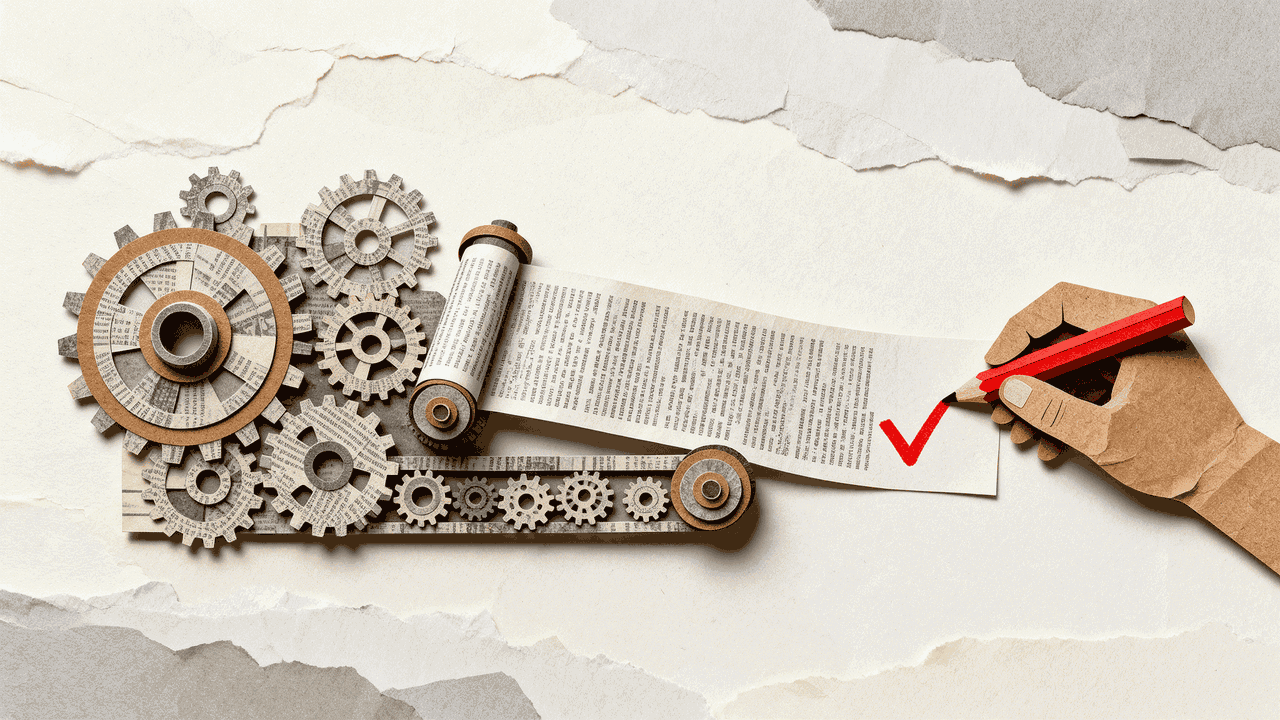
Who is responsible when the machine delivers?
Recap of the dpr ai@media conference: how the German newspaper Rhein-Zeitung uses AI
On the dpr Conference ai@media In September, newsrooms, a specialist publisher and a reader service reported on how their work has changed since machines have taken over the tasks of editing, proofreading, searching for sources and answering the phone. In some cases, the tasks are being taken over by machines, whilst responsibility remains with humans. The main difference between these organisations lies in who is responsible for final approval.

Published: 27 October 2026 | Photos: AI-generated, Magnific | AI-generated translation of the original article
In 2026, the Rhein-Zeitung adopted an AI charter, which it had spent a year drawing up, and published online. Editor-in-chief Lars Hennemann put the principle in these words: “People always have the final say.” To ensure that this statement does not remain merely a slogan, the editorial team has overhauled its processes, reports Markus Gerhold, head of local news.
The editors who produce the newspaper pages now spend a great deal of time approving articles that have been edited by AI. Whoever ultimately approves the content adds the abbreviation ‘red’ by hand. “That is the sense of responsibility we want to embed in the process,” says Gerhold. The action takes just a few seconds, but ensures that every piece of text has a person who takes responsibility for it.
The machine does the work, the human checks it
At the local office, news editors check their inboxes. They decide what sort of article a press release should become and how long it will be, in sizes ranging from XS to XXL. This triggers a workflow. The AI handles the formatting and text editing; at the end, a human checks again to ensure the result is plausible. Gerhold believes it is wiser to make a decision early on than to spend a long time reworking it later.
Page layout is also changing. In future, a placement bot will be responsible for distributing articles across the print pages, and it requires clear guidelines. The planners must therefore work in greater detail than before. Humans curate, “and the machine fills in the gaps”, as Gerhold puts it. The editorial team is already using around 133 prompts and workflows; by the end of the year, he expects this figure to reach a “very, very healthy three-figure number”. To ensure no one quietly drops out of the process, there is a feedback session once a month. “It’s no use to me if people quietly and secretly stop using the tools,” says Gerhold.
Why the Rheinpfalz does not use labels
Uwe Renners, deputy digital editor-in-chief at the Rheinpfalz, comes to a different conclusion. His editorial team uses AI to edit articles written by freelance contributors. Many of these freelancers are not trained journalists. In the past, an editor would edit these articles, and there was no ‘edited by’ credit either. That is why Rheinpfalz does not currently label AI-edited content either. ‘Whether it’s done by AI or the editor, ultimately the editor checks it over,’ says Renners. The editor decides whether the text is acceptable and bears the responsibility. The editorial team has explained the process to the freelancers at staff meetings. Where a colleague used to spend an hour on a text, they now need ten minutes.
The German Press Council takes a similar view. The Press Code does not require AI-generated texts to be labelled as such, said spokesperson Moritz Döbler in June. What matters is that the editorial team fulfils its duty of care.
AI as a ‘second pair of eyes’
At Deutscher Apotheker Verlag, Germany’s largest specialist pharmaceutical publisher, the tolerance for errors is extremely low. Publications found in pharmacies must be accurate down to the very last comma, “particularly, for example, when it comes to dosages”, says production manager Daniel Gebühr. The editorial team, comprising 15 staff members, processes Word manuscripts ranging from 150 to 1,200 pages. Until now, spelling and grammar have largely been checked by hand, aided by Word’s auto-correct function and an in-house style guide.
For the past two months, the editing department has been using the proofreading tool Textshine. It corrects a manuscript in a matter of minutes and highlights every change in revision mode. The editor then accepts or rejects the changes. “The final approval and decision-making authority should, of course, remain with a human,” says developer and managing director Alexander Seifert. What sets the tool apart is what it deliberately omits: Textshine does not make suggestions for rewording, as Seifert is convinced that this work belongs to the editing process. The publisher has also disabled one function. Spacing and microtypography continue to be managed by a typesetting tool with several thousand rules. The duplicate suggestions had obscured more important corrections.
Editor Juliane Hausner describes AI as a “second pair of eyes” that can still spot errors even in manuscripts that have already been read. Going through the suggestions takes time, but is significantly quicker than pure proofreading. There are no reliable figures available yet after two months. Nevertheless, the role is already shifting. The editor spends less time searching for errors and more time making judgements.
When the dialect gets in the way
Some new tasks only become apparent once the AI tool is being used in day-to-day work. The publishing house Nürnberger Presse (VNP) has been running the AI podcast “Erlangen am Abend” since May. On weekdays from 5 pm, an AI voice summarises four news stories of the day. A service provider prepares the news items, and between 3 pm and 4 pm, an editor from the *Erlanger Nachrichten* listens to them. The aim is 15 minutes a day. At present, it takes around 25 minutes; on bad days, three-quarters of an hour.
The reason is the Franconian dialect. The language AI being used is not very adept at pronouncing place names. “For a local media outlet, it’s obviously disastrous if place names are pronounced incorrectly,” says Georg Körfgen, head of local editorial teams at the VNP. That is why colleagues have been specially trained to use a new tool and correct the pronunciation retrospectively. Local editors acting as speech coaches for a machine – this role was not part of any project plan. Körfgen draws a lesson from this, which he himself calls ‘the classic’. The editorial team should have been told much earlier why they were taking on this additional task and what the aim was. The podcast is due to be up and running in all local newsrooms by early 2027.
For its next project, the VNP will define roles from the outset. A ‘topic radar’ is to analyse municipal and other sources. The VNP strictly separates the roles of topic managers and reporters, and the radar supports the topic managers in their work. Körfgen describes it as an additional colleague who suggests topics but does not write anything himself.
Where the time saved goes
CH Media in Switzerland publishes around 18 titles across an area comprising 750 local authorities. Every day, numerous journalists used to scour the same local authority websites for news. This routine is now being taken over by a tool called Hugo Scout, developed in collaboration with an external service provider. It scans a curated list of sources, including attached PDFs such as local council minutes, summarises the content and, if requested, writes a draft using the organisation’s in-house prompt. The editorial team spent two and a half years refining this prompt. “A prompt that still looks the same after two and a half years would make me a bit nervous,” says Alexandra Stark, AI expert at CH Media. She still reads the source herself, though. “Because we ultimately have to give the go-ahead as journalists, I naturally want to know what’s in there.”
Stefan Trachsel, Head of AI Transformation and Automation, openly admits that, on balance, there is less work to be done. CH Media intends to reinvest these resources in reporting that subscribers pay for.
The VNP takes a similar approach to its reader service. Since the AI assistant Chiara has been handling standard enquiries such as holiday interruptions and delivery complaints, service staff have been able to shift their focus from high-volume tasks to customer retention and quality assurance, reports Beran Kiyak, Head of Customer Care. He himself checks every day to see what Chiara has and hasn’t managed to complete. This, too, is a new ongoing task. Both organisations have agreed in advance how the hours saved will be allocated. Without this agreement, the time can easily be lost in day-to-day operations.
How much control does each step require?
Matthias Kraus, founder of Mintloop, who set up Xpublisher 15 years ago, provided a framework for this. He explained that ‘control’ does not mean that a person has to approve every single step. He distinguishes between three levels, and the examples given at the conference fit neatly into these categories.
Minimal impact, clear rules: The agent works and makes decisions independently. At VNP, for example, the process of identifying the subject of a reader’s email is now carried out autonomously. Initially, the team checked every single classification.
Moderate impact: The machine does the groundwork; a human carries out the checks. This is how Textshine operates in proofreading, as does Hugo Scout at CH Media and the VNP’s planned ‘Themenradar’.
High legal, economic or editorial significance: It is up to the individual to decide. This includes approval with an abbreviation at the Rhein-Zeitung and authorisation by the editor at the Rheinpfalz.
“The key is ‘the right checks for each stage’,” says Kraus. It is equally important to be able to trace later which model was running, which tests were carried out and who approved what.
Raphael Baier, the current managing director of Fabasoft Xpublisher, took the same line at the conference. He said that AI should be allowed to carry out research, translate and generate variations. “Ultimately, the person in charge is still a human being, and it is they who give the final go-ahead for approval and publication.”
What will no longer take place in future
The White Paper “10 steps to choosing the right publishing system“ (in German) Fabasoft Xpublisher requires clearly defined roles, permissions and approvals for the target process. It explicitly includes the question of ‘what will deliberately no longer be done in future’ as part of change management. The conference provided answers to this from two perspectives.
On the human side, routines are being done away with. At CH Media, journalists no longer have to click their way through local council websites. At Apotheker Verlag, the editorial team no longer has to search line by line for typos. In the readers’ service department, nobody has to manually record every holiday absence any more.
On the part of the machine, there are deliberate choices not to use certain features. Textshine does not rephrase text. The Rhein-Zeitung does not allow the AI to assign editorial abbreviations autonomously. The VNP reader service continues to respond personally to emails containing multiple or complex enquiries. “Even if we could, we don’t do it,” says Kiyak. During the discussion following the Rhein-Zeitung’s presentation, a practical recommendation was made. Alongside the list of what the AI is supposed to do, there should be a second list of everything it is expressly not allowed to do, written in such a way that every colleague can understand it.
For publishers, this means incorporating both lists into the planning process before the first tool is rolled out. This involves three key decisions:
Who is losing weight? For every AI-supported step in the process, there is a designated role responsible for approval and a way of ensuring that this approval is traceable.
What’s new? Monitoring tasks such as correcting pronunciation, carrying out daily spot checks and maintaining prompts take time, which is factored into the schedule.
Where does the time we save go? Management decides this in advance, before day-to-day business takes up all the available hours.
Conclusion: Define responsibilities straight away
In all five organisations, AI is changing who does what. Page layout editors are becoming fewer in number, editors are assessing proposals, local news editors are developing a distinctive voice, and service staff are looking after regular customers. Anyone who fails to explicitly define who is responsible for approving content during this restructuring will realise the consequences by the time the first mistake occurs, at the very latest.
Read more: The white paper “10 steps to choosing the right publishing system“ (i German) describes how publishers plan roles, approvals and change management when implementing a publishing system.
The article is part of the Channels: Digital Publishing Technologies, which focuses on content strategies and processes. The channel is sponsored by Fabasoft Xpublisher.